A Mississippi Genealogy & History Collection
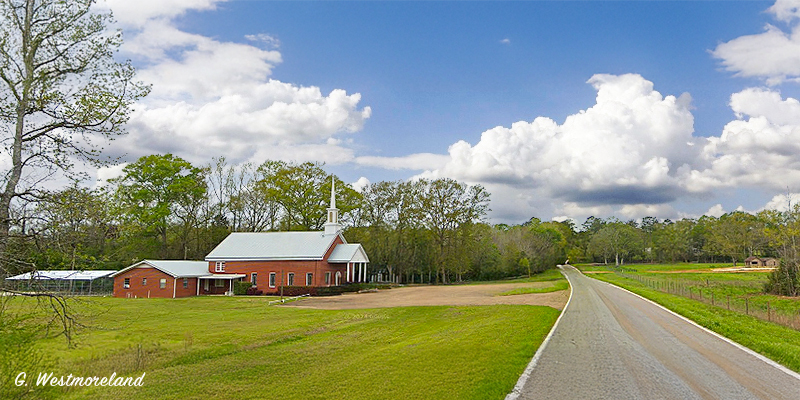
Old Hebron is one of the earliest and most culturally significant settlements in the area that would eventually become Jefferson Davis County. Its story reflects the evolution of South Mississippi from frontier homesteads to organized communities anchored by churches, schools, and the timber economy. Although today it is a quiet rural settlement, Old Hebron once stood as one of the region’s central crossroads.
Early Settlement and Formation
The origins of Old Hebron trace back to the early-to-mid 1800s, when pioneering families—many migrating from Georgia, Alabama, and the Carolinas—began settling the piney woods of what was then Lawrence County. These settlers established small farms along the gently rolling terrain, clearing land for cotton, corn, livestock, and turpentine production.
By the 1840s and 1850s, the settlement had grown enough to warrant a church, which quickly became the heart of community life. This first gathering place, eventually known as Old Hebron Baptist Church, played a foundational role not only in worship but also in education, communication, and social organization. Early church minutes, if located, often contain valuable genealogical traces of the families who formed the backbone of the community.
Civil War and Reconstruction Era
Like many settlements in the region, Old Hebron was deeply affected by the Civil War. Many local men served in Mississippi regiments, and the postwar years brought hardship and rebuilding. Despite economic strain, rural institutions such as churches and local schools helped stabilize the community.
Reconstruction also brought changes in regional boundaries and identity. When Jefferson Davis County was created in 1906 from portions of Covington and Lawrence counties, Old Hebron found itself positioned within the new county’s northern area. Though small, the community already had long-established roots and an identity distinct from newer settlements.
Rise of the Timber Industry and Community Expansion
The late 1800s and early 1900s marked a transformative period. The vast longleaf pine forests of the region attracted sawmill operators and turpentine crews, invigorating the local economy. New rail lines in nearby communities—particularly in Prentiss and New Hebron—boosted commercial opportunities, even if Old Hebron itself remained slightly off the main rail corridor.
During this timber boom, Old Hebron developed a network of family farms, churches, schools, and community stores. The area around Old Hebron Baptist Church remained an important gathering point, serving a large rural district prior to school consolidation in later decades.
The Old Hebron Cemetery, located near the church, became the final resting place for many of the community’s earliest settlers and later generations. It remains one of the richest genealogical resources in northern Jefferson Davis County.
Old Hebron vs. New Hebron: A Tale of Two Communities
The relationship between Old Hebron and New Hebron is one of the most interesting aspects of the area’s history.
When the railroad came through in the early 1900s, the new line bypassed Old Hebron by several miles. In response, residents and merchants began relocating closer to the depot, forming what became known as New Hebron. Stores, schools, and other community functions gradually shifted to the new location. Old Hebron, while still active, became the quieter “original settlement,” known increasingly by the “Old” prefix.
This shift mirrors patterns seen across rural Mississippi, where railroad placement determined which communities thrived and which remained small, though historically significant.
20th-Century Life and Community Continuity
Throughout the twentieth century, Old Hebron remained a close-knit rural settlement centered around church, family, and farming. Many residents worked timber, agriculture, or jobs in nearby towns while maintaining deep roots in the Old Hebron community.
Old Hebron Baptist Church continued as the central institution, hosting revivals, homecomings, Sunday schools, and community events. The names appearing in the cemetery and church rolls—Buckley, Lee, Cliburn, King, Stephens, Davis, Chase, and others—represent some of the families whose presence defined the area for generations.
Present-Day Old Hebron
Today, Old Hebron is quiet, rural, and steeped in history. Though overshadowed in size and commerce by New Hebron, it retains its identity through its historic church, cemetery, and the families who continue to trace their origins to the community’s early roots.
For genealogists, Old Hebron is a treasure with cemetery records preserve some of the earliest settlers in the region; church histories may contain membership lists, disciplinary notes, baptisms, marriages, and deaths; land records from Lawrence and Jefferson Davis counties help trace families before and after county realignments.
Old Hebron stands today not just as a geographic location but as a historical landmark—one of the foundational communities of northern Jefferson Davis County, carrying forward a legacy of faith, family, and continuity in Mississippi’s piney woods.
Old Hebron is located on State Highway 42 about 2 miles southeast of New Hebron.